How to choose reference tracks for your mix
By Conor · 5 November 2026 · 7 min read
Referencing only works if the track you compare against is the right one. Put a dense club record next to your acoustic ballad and every difference you hear is a difference in style, not a problem with your mix. Chase those differences and you'll end up somewhere worse than where you started.
So before you think about level matching or what to listen for, it's worth a few minutes choosing what you're comparing against. This guide covers what makes a good reference, how many to use, and how to keep a shortlist so you're not hunting for one every time.
Quick disclosure: I make a plugin, Stream AB, that A/Bs your mix against whatever is playing on your computer. I'll mention it where it fits, but none of this depends on it.
What a reference is for
A reference is a known-good answer to the questions you can't answer by ear after six hours: is the low end too heavy, is the vocal loud enough, is the top end harsh or dull? You're not trying to copy it. You're borrowing someone else's finished decisions as a ruler, so you can tell whether yours are in the right place.
That's why the choice matters. A ruler is only useful if it measures the same kind of thing.
What makes a good reference track
The same genre, ideally the same corner of it
Genre sets most of the expectations you're checking: how loud the kick is against the bass, how far forward the vocal sits, how bright the top end is. A modern trap record and a 90s hip-hop record are both hip-hop and have very different low ends. Pick something from the same corner of the genre your track lives in, not just the same shelf.
A similar arrangement
Instrumentation changes everything. A track built on piano and vocal will always sound thinner and more open than one with three layers of distorted guitars, and that's not something to fix. Look for a reference with roughly the same ingredients: similar drums, a similar bass role, a lead vocal if you have one, a similar density in the chorus.
Tempo and key help too, more than people expect. A bass line sitting in the same register as yours gives you a much fairer picture of the low end than one an octave higher.
Well made, and released properly
Use a track that is genuinely well mixed and mastered. Popular isn't the same thing, so trust your own ears and the opinions of people whose work you rate.
Use the official release, at the best quality you can get. Not a live version, not a fan upload, not a low-bitrate rip. If you're referencing from a streaming service, check its quality settings first; the Spotify referencing guide covers which ones to change. Watch for remasters too. A remaster of an older record can sound quite different from the original, so pick the version whose sound you're actually after.
A track you know well
This is the one people skip. A reference you've heard hundreds of times, on lots of systems, tells you about your room or headphones as well as your mix. If a track you know inside out suddenly sounds bass-light on your monitors, the monitors are lying to you, and you've learnt something before you've touched a fader.
A brand-new track you heard yesterday can't do that, because you have no idea what it's supposed to sound like on your setup.
Not too extreme
Some brilliant records make unusual choices: a deliberately buried vocal, huge sub, lo-fi top end. They're great to listen to and risky to steer by, unless that sound is exactly what you're going for. Your safest references sit near the middle of your genre.
How many to use
Two or three, rather than one. Any single track has its own quirks; what several have in common is what your genre actually sounds like. If all three references have a louder vocal than yours, that's a real finding. If only one does, it's probably that track's style.
It can help to give each one a job:
- A whole-picture reference: the closest overall match to the track you're making.
- A low-end reference: something with a kick and bass relationship you trust, ideally in a similar key.
- A vocal reference: a track where the vocal sits the way you want yours to, in level, brightness and space.
On top of that, keep one or two calibration tracks that you use on every mix, whatever the genre, purely to remind your ears what your room or headphones sound like at the start of a session.
More than four or five on one mix and you stop learning anything. You end up comparing references with each other instead of with your mix.
Keep a shortlist
Choosing references from scratch on every mix is slow, and it's easy to grab whatever you happened to listen to last. A small shortlist per genre fixes that.
A playlist in your streaming app is all you need. Add a track when you hear one that would make a good ruler, and write down, even in the playlist description, what it's good for: "great low end", "vocal level", "bright but not harsh". Prune it now and then. Tastes and production styles move, and a list that only ever grows becomes hard to use.
If you work with clients, ask them for two or three references early, then check them against the points above. A client's favourite song isn't always a good mixing reference, but it tells you what they're hoping for, and you can suggest a closer match from your own shortlist.
Keeping references in Stream AB
Stream AB plays whatever is already playing on your computer, so a playlist in Spotify, Apple Music or a browser tab works with it as it is, in the free version. Start the track, put the plugin on your master, and the A/B switch flips between your mix and the reference.
The full version adds search, so you can type a track and start it playing in Spotify, Apple Music, YouTube or TIDAL without leaving your DAW. Spotify needs no Premium. Services often list several versions of a song, so pick the exact one you want from the results.
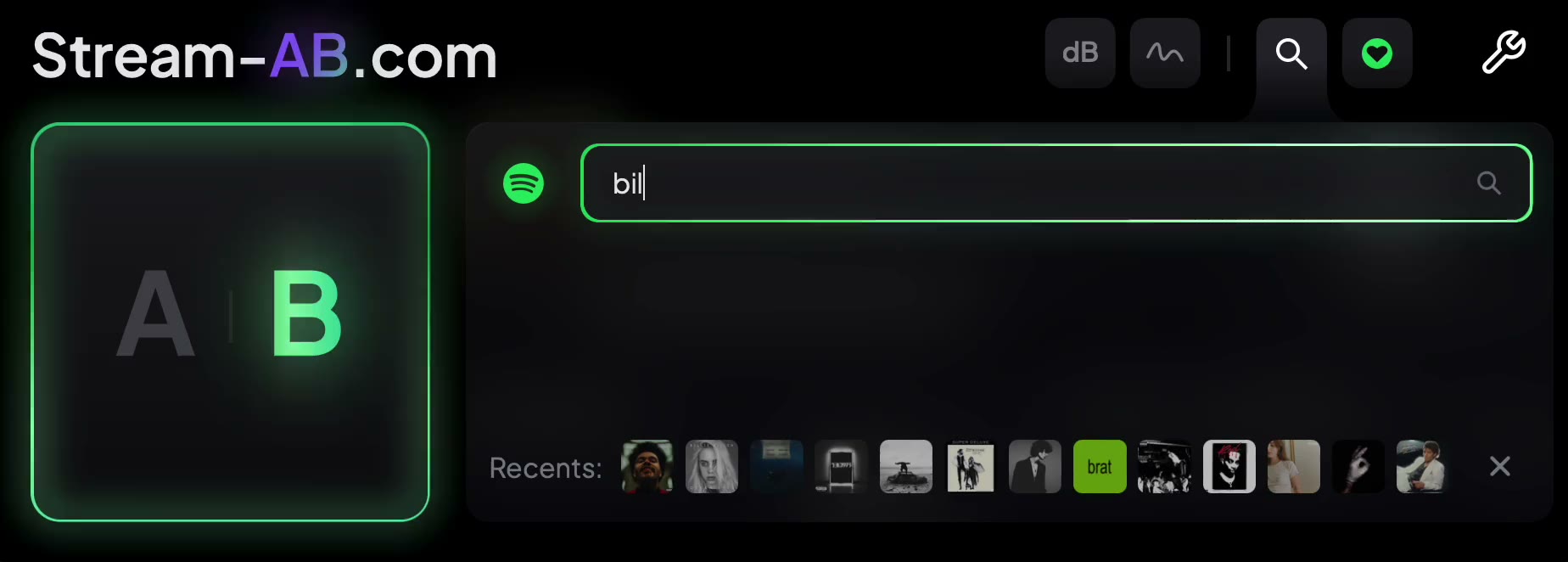 The search box open, with a strip of recent references below.
Tracks you've played stay as a strip of recent references, and you can heart a search result, or press Save while a track plays, to keep it in a saved list. That list is effectively the shortlist above, one click from your mix. How it works has the details.
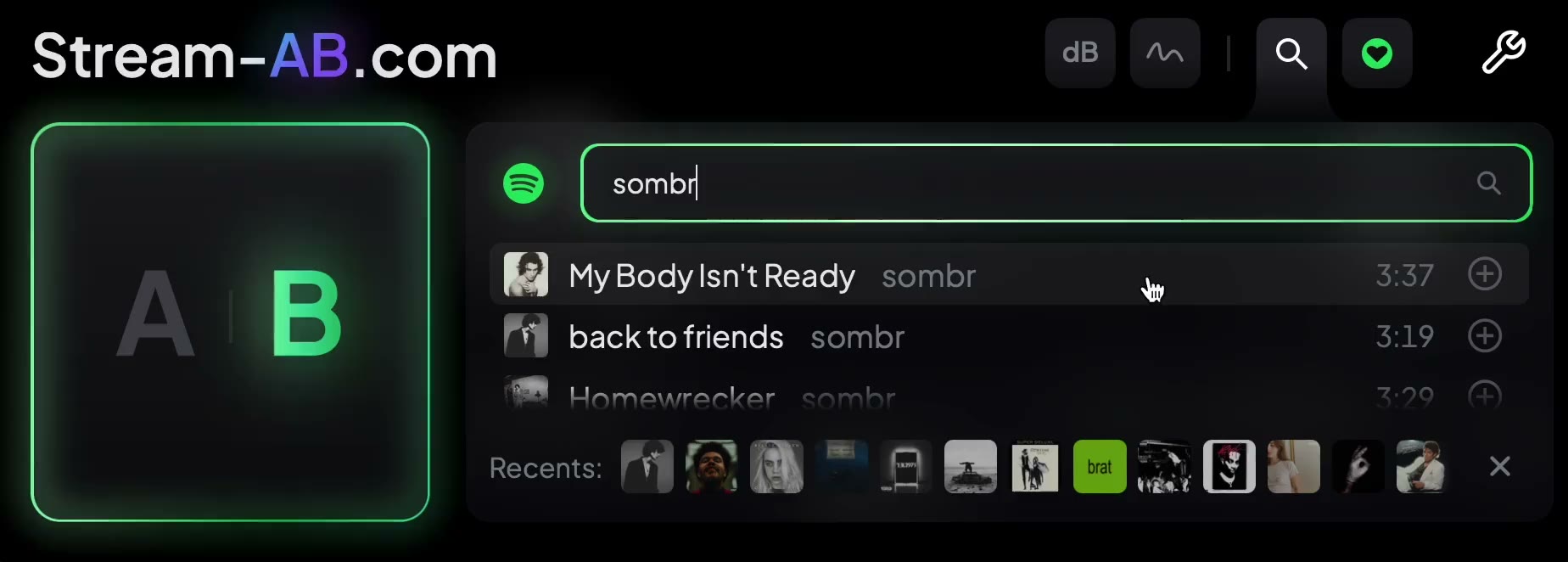 Search results listed, with a button on each to save it.
Test a reference before you trust it
Once you've picked a candidate, give it a quick audition against your mix before you start making decisions from it:
- Level-match it. Loop matching sections, chorus against chorus, and turn the louder side down until neither jumps out when you switch. Without this, the louder one wins every time. The level-matching guide goes through it step by step.
- Switch a few times and notice the differences. Ask whether each one is something you'd want to change, or just a different style.
- Drop it if nearly every difference is stylistic. If the reference has a completely different arrangement, energy or sound, it isn't telling you anything useful about your mix. Find a closer one.
A good reference makes you think "my vocal's a bit low" or "my top end's dull", not "these are just different songs".
Common mistakes
Picking the loudest track you can find
A loud master only sounds better until you level-match it. Choose references for their balance and tone, not their loudness. Streaming services turn loud masters down anyway, which the LUFS guide covers.
Changing references halfway through a decision
If you're working on the low end, stick with the same reference until you've finished. Swapping to a different track every few minutes means every comparison starts from zero.
Chasing a reference too far
A reference is a guide, not a target. Once your mix sits in the same neighbourhood on low end, vocal level and brightness, the remaining differences are often the parts that make your track yours. Stop there.
Expecting a mix to match a master
If you're still mixing, your track will sound less dense than a finished master even at the same loudness. That's what mastering adds. Use references to judge balance and tone, not how finished it sounds.
A quick checklist
- Same genre, and the same corner of it
- Similar instruments, energy and, ideally, tempo and key
- Genuinely well made, official release, best quality available
- At least one you know well on your own setup
- Two or three references, each with a job
- A shortlist playlist, with a note on what each track is good for
- Level-matched and auditioned before you trust it
Ten minutes choosing references saves hours of chasing the wrong thing. Once you have a shortlist you trust, that ten minutes becomes about thirty seconds.